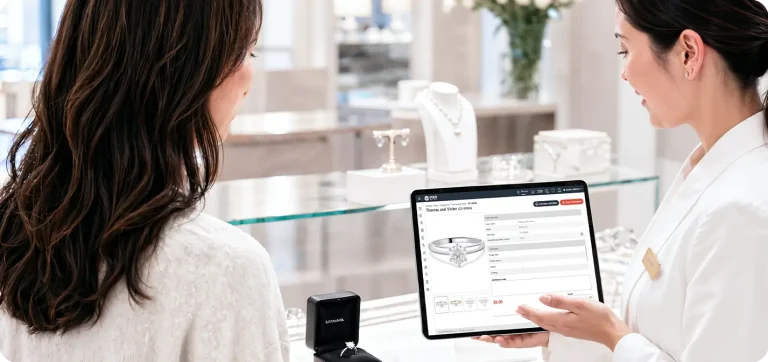
The real role of a modern jewelry POS In the fast-paced environment of a jewelry retail store, proce
July 13, 2026

A jewelry point of sale is often judged by what happens in a few seconds at checkout. Can it process a payment? Can it print or email a receipt? Those capabilities matter, but they are not the whole job. In a jewelry store, the sale is connected to valuable inventory, detailed product attributes, customer history, repairs, custom orders, memo items, and sometimes a workshop or manufacturing team. A modern jewelry point of sale should make those connected workflows easier to manage, not force employees to maintain separate records after the customer leaves.
Generic point-of-sale software can record transactions. Jewelry retail requires more context. When a customer asks whether a ring is available in a different size, whether a similar diamond can be sourced, or when a repair will be complete, the associate needs dependable information immediately.
If the answer is held in a spreadsheet, an email inbox, or a paper job bag, the customer experience slows down and the store loses confidence at the point of sale. The retail counter and the back office should work from the same operating facts.
The information a jewelry POS should connect
PIRO Retail presents this model as a jewelry POS interface for the store paired with a back-office environment for inventory, purchasing, memo, job orders, and repair-related workflows. The point is not to add complexity to the salesperson’s day. It is to keep the necessary complexity organized behind a clear sales process.
Many jewelry retailers compare a new system against the visible cost of its implementation. A better comparison is the cost of the new system against the cost of continuing with the current way of working. Manual processes are rarely free: they require employees to repeat work, check information in multiple places, correct errors, and wait for answers from another department.
This is the cost of inaction. It can show up as an out-of-stock experience when the merchandise is actually elsewhere, an unnecessary reorder, a missed follow-up, or a higher administrative workload as sales increase.
Where the hidden cost often appears
Retailers do not need to assign speculative values to every strategic benefit. They can begin by measuring the processes they already know are repetitive, uncertain, or difficult to audit.
Inventory is both a major investment and the basis of the customer conversation. Jewelry stock is highly specific: a finished ring can have a particular size, metal, stone, and design detail, while loose diamonds and gemstones may carry additional attributes.
Memo goods require a clear distinction between what the store owns and what it holds on behalf of a supplier. If the records do not reflect reality, sales associates cannot confidently recommend alternatives, managers cannot see which pieces are aging, and buyers may make decisions based on incomplete information.
The operational foundation
PIRO’s inventory materials describe tracking for metals, diamonds, precious stones, finished goods, and consumables, while PIRO Retail describes jewelry inventory tracking for metals, diamonds, semi-components, and finished items with product-specific attributes. Used consistently, that information gives the retailer a foundation for more accurate merchandising, replenishment, and customer service.
The relationship with a jewelry customer often continues after the initial transaction. A repair can require intake notes, estimates, parts, workshop work, customer approval, and a pickup notification. A custom order may involve a deposit, a design conversation, stone selection, changing delivery expectations, and several production stages.
When this information is disconnected from the sales process, associates must search for updates and customers receive different answers depending on whom they ask. A connected workflow gives the store a single record of what the customer requested, what has been promised, and what needs to happen next.
The connected record should show
PIRO’s repair and custom-order materials describe tracking of custom jewelry orders and repair workflows, including progress and deadlines. This is important for customer communication, but it is also an internal control. For retailers with an in-house workshop or an associated production function, the same discipline can support better material control and fewer costly re-dos.
A decision about jewelry retail software should be commercially realistic. The business does not need an elaborate accounting model to start, but it should separate expected operating benefits from the total investment required to achieve them.
A practical starting framework
Labor capacity released can include time no longer spent on duplicate entry, manual reporting, product searches, and reconciliation. Inventory and purchasing savings can include fewer avoidable purchases, more informed replenishment, and fewer preventable discrepancies. Additional contribution margin should be applied conservatively: it is not every sale made through the system, but the incremental value that the better process makes realistically possible.
The cost side must be just as complete. Total Cost of Ownership, or TCO, includes more than a monthly license: implementation, configuration, data migration, training, integrations, internal staff time, required hardware, and ongoing support.
For example, a retailer might find that better inventory visibility and less manual administration create a conservative annual benefit of $45,000. If the annualized system cost is $24,000, the simple ROI calculation would be 87.5 percent. The example is illustrative, not an industry benchmark; its value is in showing ownership how to replace assumptions with its own data.
A jewelry point of sale is most useful when it connects to the systems the retailer already depends on. For a store that sells online, inventory and order information must be considered across both the digital storefront and the physical location.
If an item is sold online but is still available at the counter, the business risks disappointing a customer and losing trust. If staff manually adjust each channel after every transaction, the supposed integration can become another recurring task.
Questions to ask about every integration
PIRO describes POS, inventory, and broader operational workflows in one jewelry-business environment, and its published materials also describe Shopify and QuickBooks-related connections. The goal is not simply to display a logo for an integration. It is to eliminate the duplicate entry or delayed update that is causing the operational problem.
Jewelry businesses manage high-value, easily movable inventory. That makes auditability more than a back-office preference. Managers need to understand where valuable items are, how they moved, what customer or job they relate to, and which employee or process created a transaction.
A system with consistent records and traceable workflows can support internal accountability and make physical counts, reconciliation, and insurance-related documentation less stressful.
Why this matters at the counter
Luxury customers expect accurate answers, especially when they have placed a deposit, entrusted an item for repair, or ordered a custom piece for an important date. Operational control therefore supports the customer experience rather than sitting separately from it.
The return from a jewelry point of sale is created through adoption, not simply through ownership. If product data is incomplete, sales associates continue using separate lists, or repair stages are not updated, the business will not gain the visibility it expected.
Before selecting a system, document the current baseline. Measure the time spent on manual reconciliation and product lookups. Record the number of open repairs or custom orders whose status is difficult to find. Review inventory adjustments, supplier memo activity, stockouts, and avoidable reorders.
Useful 12-month KPIs
Management can review these indicators periodically, compare them with the original baseline, and adjust workflows where adoption is weak. This turns a software purchase into a practical operating plan for the store.
PIRO Retail is intended for jewelers that need a retail POS and back-office system to work together. Its relevant value is not limited to a checkout screen. It lies in the ability to connect sales, customer information, inventory, memo, repairs, custom orders, purchasing, and related workshop activity in a way that fits the operating realities of a jewelry store.