Custom jewelry work is where jewelers make their best margins and build their most loyal customers &
September 09, 2026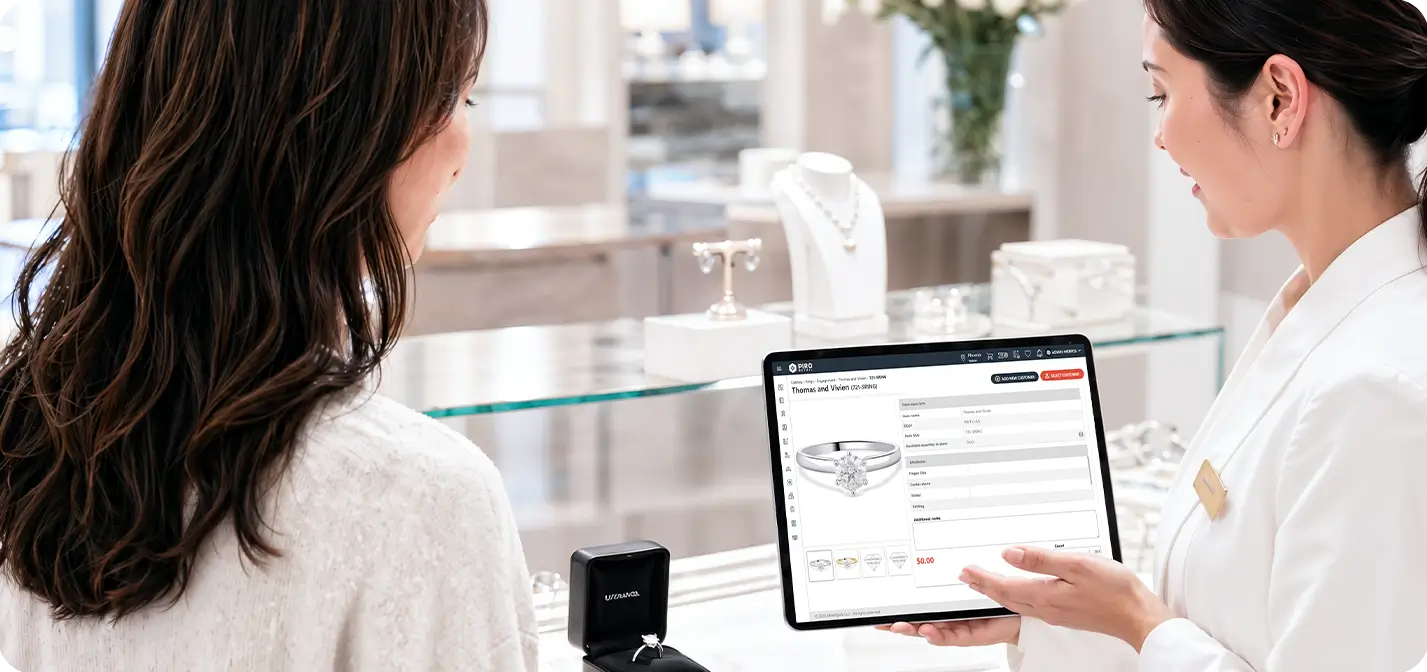

Retail is changing quickly, but not always in the obvious ways.
The conversation usually starts with AI, e-commerce, personalization, or changing consumer expectations. But underneath all of that is a more practical issue: many retailers are still trying to run modern businesses on systems that were built for a much simpler version of retail.
Deloitte’s 2026 Retail Industry Global Outlook highlights several forces shaping the retail industry: value-seeking consumers, AI moving from experimentation into execution, more personalized customer experiences, supply chain transformation, and tighter financial discipline. One of the clearest warnings in the report is that 44% of retail executives say legacy systems are slowing down innovation.
That insight applies strongly to the jewelry industry.
Independent jewelry stores are no longer just ringing up sales at the counter. Many now manage in-store sales, online orders, custom design projects, repair jobs, appraisals, layaways, memo goods, supplier orders, special orders, customer communication, and complex inventory across multiple product types.
A traditional POS system may still process a transaction. But in 2026, that is no longer enough.
For jewelry retailers with repair and custom-work operations, the real question is not whether the POS “works.” The better question is:
Can the system support the way your jewelry business actually runs today?
For many stores, the answer is becoming no.
A legacy POS system usually does one thing well: it records sales.
That made sense when the main purpose of the system was to complete a checkout, print a receipt, update inventory, and close the register at the end of the day.
But jewelry retail is rarely that simple.
A customer may come in to resize a ring. Another may request a custom engagement ring quote. A third may purchase a chain online and pick it up in-store. A fourth may leave a family heirloom for repair. Meanwhile, the owner needs to know which jobs are waiting for stones, which repairs are ready for pickup, which items are on memo, which pieces are underperforming, and which online listings are out of sync with store inventory.
That is not just point-of-sale.
That is operations.
This is where many older systems start to break down. They may handle sales, but they often struggle with the workflows that happen before and after the sale: intake, quoting, approvals, production steps, repair tracking, customer updates, inventory movement, and margin control.
For a jewelry store with an in-house workshop, the POS should not be isolated from the bench. The sales counter and the workshop are part of the same customer experience.
Jewelry inventory is different from most retail inventory.
A clothing store may track size, color, and style. A jewelry store may need to track metal type, stone type, carat weight, ring size, vendor, certification, serial number, labor, findings, semi-finished components, finished goods, memo items, repairs, and custom project materials.
The financial risk is also higher. One misplaced diamond, one incorrect gold weight, or one inaccurate item record can create a real loss.
This is why inventory visibility matters so much. Independent jewelers need to know what they have, where it is, what it cost, whether it is available for sale, whether it is assigned to a job, whether it is listed online, and whether it has already been promised to a customer.
A legacy POS may show that an item is “in stock.” But that is not always enough.
A modern jewelry store needs answers like:
PIRO Retail, for example, is positioned around jewelry POS, inventory management, custom orders, repair tracking, workshop operations, and Shopify integration in one system. Its site describes support for complex inventory such as metals, diamonds, semi-components, finished items, ring sizes, memo management, reorder points, and back-office workshop workflows.
That is the direction jewelry retail is moving: away from disconnected tools and toward operational visibility.
Many jewelers still manage repair and custom work through a mix of paper envelopes, spreadsheets, sticky notes, email threads, and memory.
That might work when volume is low. But it becomes risky as soon as the store gets busier.
Repair and custom work require accountability. Staff need to capture details correctly at intake. The workshop needs clear instructions. The customer needs updates. The owner needs visibility into status, cost, labor, deadlines, and profitability.
When this process is disconnected from the POS, several problems appear:
This is a major reason jewelry stores outgrow legacy POS systems. The business evolves beyond simple retail transactions, but the software does not evolve with it.
A modern jewelry POS should allow staff to create repair and custom order tickets directly from the sales counter, capture design notes and materials, assign work to the workshop, track job status, invoice accurately, and keep the customer informed.
For a jewelry business, this is not a side feature. It is core infrastructure.
For years, many independent jewelers treated e-commerce as separate from the physical store.
The store had one system. The website had another. Inventory updates were manual. Online orders required extra admin. Product information was copied from one place to another.
That approach is becoming harder to sustain.
Customers do not think in channels. They see one brand. They may browse online, ask a question by phone, visit the store, request a quote, approve a custom design, pay by link, and pick up the finished item later.
If the systems behind that experience are disconnected, the store feels slower and less reliable.
This is especially important for jewelry because many products are one-of-a-kind or low quantity. Overselling a mass-produced item is inconvenient. Overselling a unique ring or diamond can damage trust.
A modern jewelry store system should help keep online and offline inventory aligned, reduce double entry, and make order handling smoother.
PIRO Retail describes bidirectional Shopify integration designed to reduce manual product and price updates, eliminate double data entry, and bring online orders into PIRO without manual input.
For independent jewelers, e-commerce does not necessarily mean becoming a huge online retailer. It means creating a connected buying journey where the website, store, and workshop all work from the same operational truth.
AI is one of the biggest retail themes in 2026, but for most jewelry stores, the first step is not buying an AI tool.
Deloitte’s outlook points to AI becoming more embedded in retail operations, marketing, personalization, and decision-making. It also highlights the problem: legacy systems and fragmented data architectures slow innovation.
This matters because AI is only as useful as the data it can access.
If customer history is in one system, repair notes are in another, product details are incomplete, custom quotes are in spreadsheets, and inventory is manually adjusted, then AI cannot create much value. The foundation is too messy.
For jewelry retailers, clean operational data can support better decisions long before advanced AI is introduced.
It can help answer:
This is why the future of jewelry retail is not just about AI. It is about becoming AI-ready.
And becoming AI-ready usually means replacing disconnected, outdated systems with cleaner, more connected infrastructure.
Jewelry stores operate in a margin-sensitive environment.
Metal prices fluctuate. Stone costs vary. Labor is expensive. Custom projects can become unprofitable if quotes are inaccurate. Repairs can lose money if parts and bench time are not tracked properly. Discounts can quietly erode profit if staff do not have clear guidelines.
Deloitte’s report emphasizes financial discipline and margin management as major retail priorities for 2026. Retailers are expected to focus on pricing, product mix, cost control, and profitable growth.
For jewelers, this is especially relevant.
A legacy POS may record what sold. But it may not give the owner enough visibility into whether the business is protecting margin across custom work, repairs, special orders, memo goods, and online sales.
A jewelry-specific system should help connect pricing, cost, labor, materials, inventory movement, and reporting. That gives the owner a clearer view of what is actually profitable.
This is where software becomes more than admin. It becomes a management tool.
Independent jewelry store owners often carry too much operational knowledge in their heads.
They know which customer is waiting for a quote. They know which repair is urgent. They know which vendor is late. They know which showcase has the high-value pieces. They know which staff member handled a custom request.
But as the business grows, owner-memory stops scaling.
A modern jewelry POS and management system should make the business easier to run without requiring the owner to personally track every detail.
That means better dashboards, clearer job statuses, searchable customer history, inventory movement tracking, reporting, and role-based workflows.
This is especially important for stores with both retail and workshop activity. The owner needs visibility across the entire business, not just the cash drawer.
A store may not need new software just because its current system is old. But there are clear signs that the business has outgrown it.
You may have outgrown your legacy POS if:
These workarounds may seem normal, but they usually point to a larger issue: the system is no longer supporting the business model.
A modern jewelry store system should do more than process sales.
For independent jewelers with repair and custom work, the right system should include:
Jewelry-specific inventory management
The system should handle finished goods, diamonds, metals, components, memo goods, ring sizes, and item-level details.
Repair tracking
Staff should be able to create, track, update, and invoice repair jobs without relying on paper or spreadsheets.
Custom order workflow
Quotes, design notes, materials, labor, approvals, and job status should be connected.
E-commerce integration
Online and in-store inventory should stay aligned, especially for unique or limited-quantity items.
Customer history
Sales, repairs, custom orders, communication, and preferences should be accessible in one place.
Reporting and margin visibility
The owner should be able to understand performance, profitability, inventory movement, and operational bottlenecks.
Cloud access and mobility
A modern system should be usable beyond one back-office desktop, especially for trade shows, remote work, or multi-location operations.
Clean data architecture
The system should support better decisions today and prepare the business for AI-enabled tools tomorrow.
In 2026, a jewelry POS system is not just a checkout tool.
It is the operational backbone of the store.
For independent jewelry retailers, especially those managing repairs and custom work, the old model is becoming too limited. The business now requires connected inventory, workshop visibility, customer communication, e-commerce sync, margin control, and cleaner data.
Legacy POS systems were built for a different era of retail.
Modern jewelry stores need systems built for how they actually operate today.
If your store is using spreadsheets, paper repair envelopes, disconnected e-commerce tools, or manual workarounds to fill the gaps in your POS, it may be time to look at a jewelry-specific platform built for retail, repairs, custom jobs, and inventory control.
PIRO Retail helps independent jewelers manage POS, inventory, repairs, custom orders, workshop workflows, and Shopify integration in one connected system.
Schedule a PIRO Retail walkthrough and see how your store can move beyond legacy POS.